
What I Wish I Knew While Leading Insurance Carriers
Written by Kim Garland
Executive Summary
The problem of uncaught fraud is real for insurers, according to industry veteran and actuary Kim Garland, who estimates that fraud and inaccurate information cost the U.S. personal auto and homeowners insurance market an estimated $45.3 billion annually. But there is little pure economic benefit for any single insurer to wage an all-out war on fraud, he notes. Here, he offers a five-step plan based on the information he wished he had known when he was actively leading insurance carrier operations and discusses behavior-indicator technologies now available to complete the first step: identifying trustworthy versus non-trustworthy policyholders and claimants at every critical touchpoint.
From 1988 through 2023, for nearly 35 years, I worked inside insurance companies: GEICO, Safeco, AIG, State Auto and Liberty Mutual. I held roles across actuarial, product, underwriting, claims, general management and the C-suite.
For the last three years I have looked at the industry from the outside. That distance has revealed insights I wish I had possessed while leading carriers. This article is my attempt to share them.
The overarching lesson is simple and uncomfortable: living inside the insurance industry distorts one’s view of reality.
We Have Come to Accept the Unacceptable
Uncaught fraud in U.S. personal lines runs approximately $45 billion annually, roughly 8.5% of personal lines premium. Personal auto accounts for about $32 billion (nearly 9% of premium); homeowners for nearly $14 billion (about 8%). These estimates are painful to hear, and they reflect the persistent gap between the fraud we catch and the fraud that remains embedded in the system.
(Editor’s Note: The statistics cited in this article were developed by the author Kim Garland for Clearspeed. They are published in the whitepaper, “Homeowners is the first P&C market that will break.” Garland is an advisor to Clearspeed, a provider of voice-based risk assessment.)
The scary fact is that the real number may be even higher. Everywhere someone has dug into potential fraud in recent years, they have found it was larger than expected. Inside the industry we have developed our own rationalizations. We sometimes pay claims we should not simply to “make them go away.” We invented the term “social inflation” to describe the normalization of soft fraud. And we avoid intense re-underwriting of in-force books because loss ratios by years insured tend to improve.
These are all ways of not chasing uncaught fraud because we lack both practical tools and, in many cases, the institutional will to confront it directly.
The Incentives Are Misaligned
When non-value-added costs—uncaught fraud, excess litigation, process friction—enter the system, who ultimately pays?
Not the fraudsters. They extract their share.
“There is, in truth, surprisingly little pure economic benefit for any single insurer to wage an all-out war on fraud. The savings are real, but they are competed away or returned to policyholders through lower rates or improved experience.”
Not the carriers. They raise rates to cover the leakage and still target their required margin on the higher premium base. An extra $45 billion in cost is painful but not existential for the industry as a whole. If it were existential, carrier behaviors would be dramatically different.
The honest policyholders pay. They absorb higher premiums and endure the additional friction designed to constrain the dishonest minority.
There is, in truth, surprisingly little pure economic benefit for any single insurer to wage an all-out war on fraud. The savings are real, but they are competed away or returned to policyholders through lower rates or improved experience. The structural incentive favors rate adequacy over aggressive leakage reduction.
The Honest Policyholder Is the Forgotten Person
The system is engineered around the assumption of non-trustworthiness. Honest customers therefore face two penalties:
- Procedural friction intended to deter the few, applied to the many.
- Premiums that embed the cost of the leakage the system fails to stop.
The worst part is that the current system sits in the muddled middle. There is process friction supposedly intended to stop fraud, but that friction is not strong enough to stop a large amount of it. Honest policyholders therefore get the worst of both worlds: they endure the process friction and still pay extra to cover the fraud that slips through.
If we were designing personal lines insurance from a blank sheet of paper, we would never construct it this way. We would design first for the trustworthy majority, select for them, and maintain a parallel, more intensive path only for those who demonstrate higher risk of non-trustworthiness. We would not impose the cost of the second path on everyone.
Rate Increases in Perpetuity Are Not the Answer, and Homeowners Is More Exposed
Personal auto remains the larger line, but homeowners is structurally more fragile. The homeowners market has already moved beyond pure affordability stress into simultaneous affordability and availability pressure in key states (California, Florida, Texas and others). For the last seven consecutive years, homeowners premiums have increased faster than personal auto premiums.
Macro trends suggest this gap will widen. The biggest long-term impact on the personal auto insurance market will be autonomous vehicles, which will put downward pressure on industry premiums and relieve some affordability pressure. The biggest impact on the homeowners insurance market will continue to be increased building near the coast combined with no end in sight to the rapid increases in building costs (both materials and labor).
Rate increases have historically been the industry’s “cure all” answer, but rate increases in perpetuity are not a sustainable answer. If and when homeowners carriers are no longer allowed to raise rates by double digits, either by regulator mandate or policyholder revolt, a carrier will have one of three choices:
- Make no changes and accept that rate increases will lag loss cost increases, resulting in sustained underwriting losses.
- Pull out of the homeowners market in the affected areas.
- Figure out how to remove loss costs and expenses from their existing way of doing business.
My sense is that honest insureds are angrier with the industry than the industry realizes, and the day of constrained rate increases may be closer than most carriers assume.
Why Change Is So Hard
The greatest inhibitors live inside the carriers themselves.
Inertia of the status quo is powerful. Cutting fraud in half, saving tens of billions and delivering 5-10% lower premiums to honest customers requires sustained, cross-functional effort that feels harder than another round of rate filings.
Soft fraud is harder to solve than hard fraud in several important ways: It is harder to identify, the dollars at stake on any individual case are relatively small, and the people committing it are often good insureds who just had a bad moment. Soft fraud remains an unsolved problem for which the industry is poorly designed. The operating system of most carriers is optimized to minimize complaints more than to minimize fraud. Aggressive action against soft fraud generates noise from the very parties being constrained, and that noise is politically and operationally costly.
These realities explain why meaningful change has been so slow, even as the cost of inaction continues to mount.
What I Would Do If I Were Leading a Carrier Today
I would start with a mental model that forces prioritization: Assume I cannot raise rates for the next two years and cannot exit markets or restrict new business or non-renewals at scale. What would I then do?
- Identify trustworthy versus non-trustworthy policyholders and claimants at every critical touchpoint. New business, mid-term endorsements and renewals, claims first notice of loss, and billing. The goal is not perfect prediction; it is practical, real-time segmentation that lets the trustworthy majority move quickly while the higher-risk minority receive appropriate scrutiny.
- Establish a dedicated soft-fraud/claims-inflation capability. Traditional SIU is optimized for hard fraud and organized rings. Soft fraud is different in character and volume. It requires its own analytics, process design and cultural mandate.
- Fanatically pursue data accuracy on renewals. A meaningful share of renewal premium leakage stems from outdated or misrepresented information that was never corrected. Mid-term endorsement activity already creates natural touchpoints. Use them.
- Fight every non-value-added cost to the death. Fraud leakage in both underwriting and claims is the largest category, but litigation friction, unnecessary process steps and vendor leakage all belong on the same list.
- Build the brand around protecting the honest majority. There is significant competitive differentiation available to the carrier that credibly positions itself as the company that fights hardest for trustworthy customers, through both lower friction and better long-term pricing power.
This agenda must be driven from the top. Middle management will optimize for the status quo and complaint minimization. Only the C-suite can drive this type of change.
The Practical Enabler Now Exists
For decades the industry has relied on an “information verification” paradigm: Is this specific piece of information about this policyholder or claimant accurate or not? There has been no scalable, objective, in-the-moment indicator of trustworthiness that does not rely on historical data, personal identifiers, or proxies that introduce bias or lag. That gap is closing.
“I would start with a mental model that forces prioritization: Assume I cannot raise rates for the next two years and cannot exit markets or restrict new business or non-renewals at scale.”
A new class of behavior-indicator technologies has emerged. These tools analyze the behavior of the applicant, policyholder or claimant in real time. Examples include digital body language (how a person interacts with the insurer’s digital forms and applications in real time) and voice (how a person answers simple questions) to classify interactions as lower or higher risk of non-trustworthiness in near-real time. Because the signals are rooted in human behavior rather than demographics or historical records, the evaluation can be designed to be unbiased with respect to language, gender, race, age, credit or location. The assessments can be embedded directly into existing digital workflows at new business, renewal, claims and other key points in the policyholder life cycle.
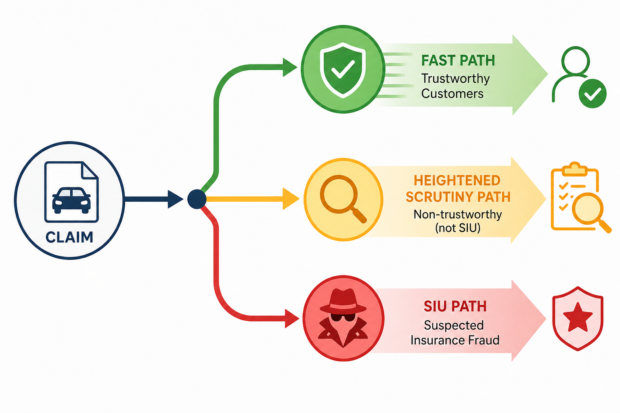
Using claims as an example, the historical two-path process (routine versus SIU) expands into three paths: a fast path for trustworthy customers, a heightened-scrutiny path for non-trustworthy but non-SIU cases, and the traditional SIU path. Trustworthy indicators accelerate the trustworthy majority and reduce expenses. Non-trustworthy indicators on previously unflagged claims surface soft fraud that was being missed.
Conservative modeling across claims, new-business and renewal underwriting points to multi-point combined ratio benefits and tens of billions of dollars in potential industry-wide savings—savings that can be shared with the honest policyholders who have been subsidizing the system.
Trustworthiness is the first new transformational variable for personal lines since credit scoring and telematics. Those earlier variables changed underwriting and pricing. Trustworthiness assessment changes the operating system itself: it allows the industry to design for trust rather than around the assumption of its absence.
The Choice for Leadership
Honest policyholders are more frustrated than most executives realize. Soft fraud is real and growing.
Carriers that continue to treat $45 billion of annual leakage as an inevitable cost of doing business will keep raising rates, adding friction and watching availability erode. Carriers that redesign around trustworthiness (selecting for it, expediting it and isolating the rest) can protect margins, improve the experience of the majority, rebuild brand trust and help keep critical markets functioning.
The technology to make the separation practical now exists. The remaining barrier is leadership will. The companies that act will differentiate. The ones that wait may find that the markets they need have already begun to fail around them.
I wish I had seen this more clearly when I was inside. The view from outside is clearer. The time to act is now.
See the original here.
